
The History of Rolex Daytona — From Racing Icon to Super Clone Favorite
Published 2026 · 25 min read
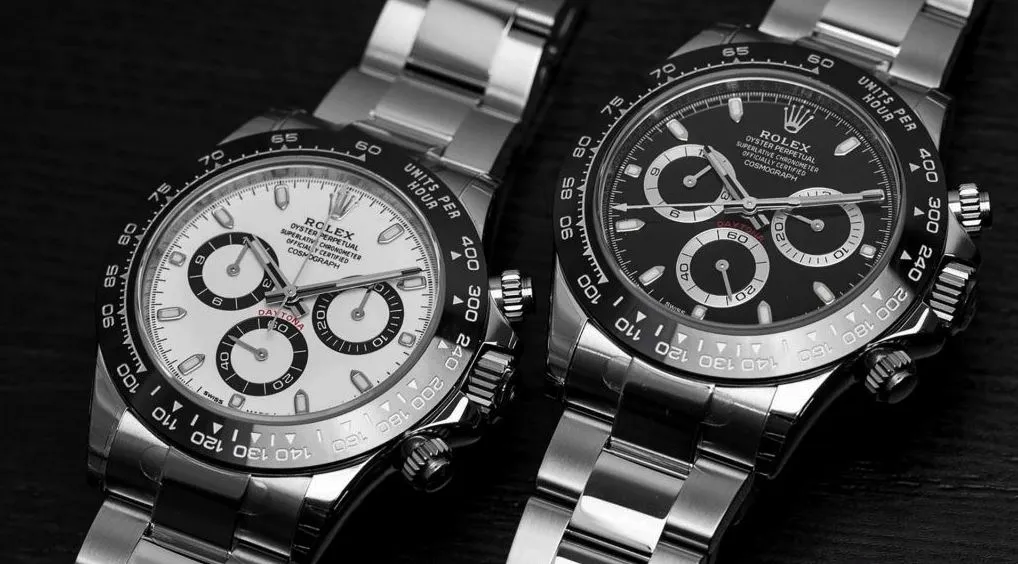
The story begins not with triumph but with failure. When Rolex introduced the Cosmograph chronograph in 1963, they were solving a problem that very few people had: measuring elapsed time and speed during motor racing. The tachymeter scale on the bezel — a set of graduated markings that allowed a driver to calculate average speed over a known distance by stopping the chronograph — was a functional tool for a niche sport.
The market did not care. Rolex dealers in the United States, particularly those near the Daytona Beach International Speedway in Florida, ordered the watches and watched them sit. The name "Daytona" was added to the dial in 1965 as a marketing measure — a direct reference to the speedway and the 24-hour endurance race that made it famous. The tactic barely moved the needle.
For the better part of two decades, the Daytona was considered a commercial disappointment. It sold to niche buyers: racing enthusiasts, aviation professionals, people who genuinely needed to measure elapsed time with mechanical precision. It was a competent tool watch. It was not a cultural phenomenon.
Then Paul Newman wore one, and everything changed forever.
Paul Newman and the Watch That Became a Legend
Paul Newman was many things — Academy Award-winning actor, racing driver, philanthropist — but in the watch world, he became the man who transformed a slow-selling chronograph into the most valuable production wristwatch in history.
The story of how Newman came to own his Daytona is itself part of the legend. His wife, actress Joanne Woodward, gave him the watch sometime in the late 1960s. She had it engraved on the caseback: "Drive Carefully Me." It was an intimate message about their lives together — Newman was an enthusiastic amateur racing driver, and Woodward's concern for his safety lived on the back of his watch.
Newman wore the watch. He wore it publicly, at racing events and premieres and on set. A photograph taken by someone who knew what they were looking at shows Newman's wrist with the Daytona on it — specifically an "exotic dial" variant, with an outer minute track and subsidiary dial layout that Rolex had produced for only a few years and discontinued. The combination of the man, the watch, the story behind it, and the relative rarity of the exotic dial created a mythology that would take decades to fully understand.
By the 1980s, collectors had started calling any exotic-dialed Daytona a "Paul Newman" — even examples that Newman himself had never seen or touched. The nickname attached to a style, not a specific watch. This is unusual in watchmaking: a reference named not for its manufacturer or specification but for the celebrity association that made collectors understand its value.
The First Generation: Valjoux-Powered Daytonas (1963–1988)
The original Daytonas — references 6239, 6241, 6262, 6263, 6264, and 6265 — used variations of the Valjoux 72 manual-wind chronograph movement. The Valjoux 72 was a Swiss movement by the Les Fils de R. Aegler company (the same company that made movements for Rolex under a contractual arrangement that dated to 1926).
The reference evolution across these numbers reflects Rolex's typical approach: continuous refinement rather than dramatic reinvention. The 6239 had pump pushers and a plain bezel. The 6263 introduced a screw-down pump pusher design for improved water resistance. The 6265 had a polished metal bezel. Each iteration refined the case architecture, the bezel design, and the dial options.
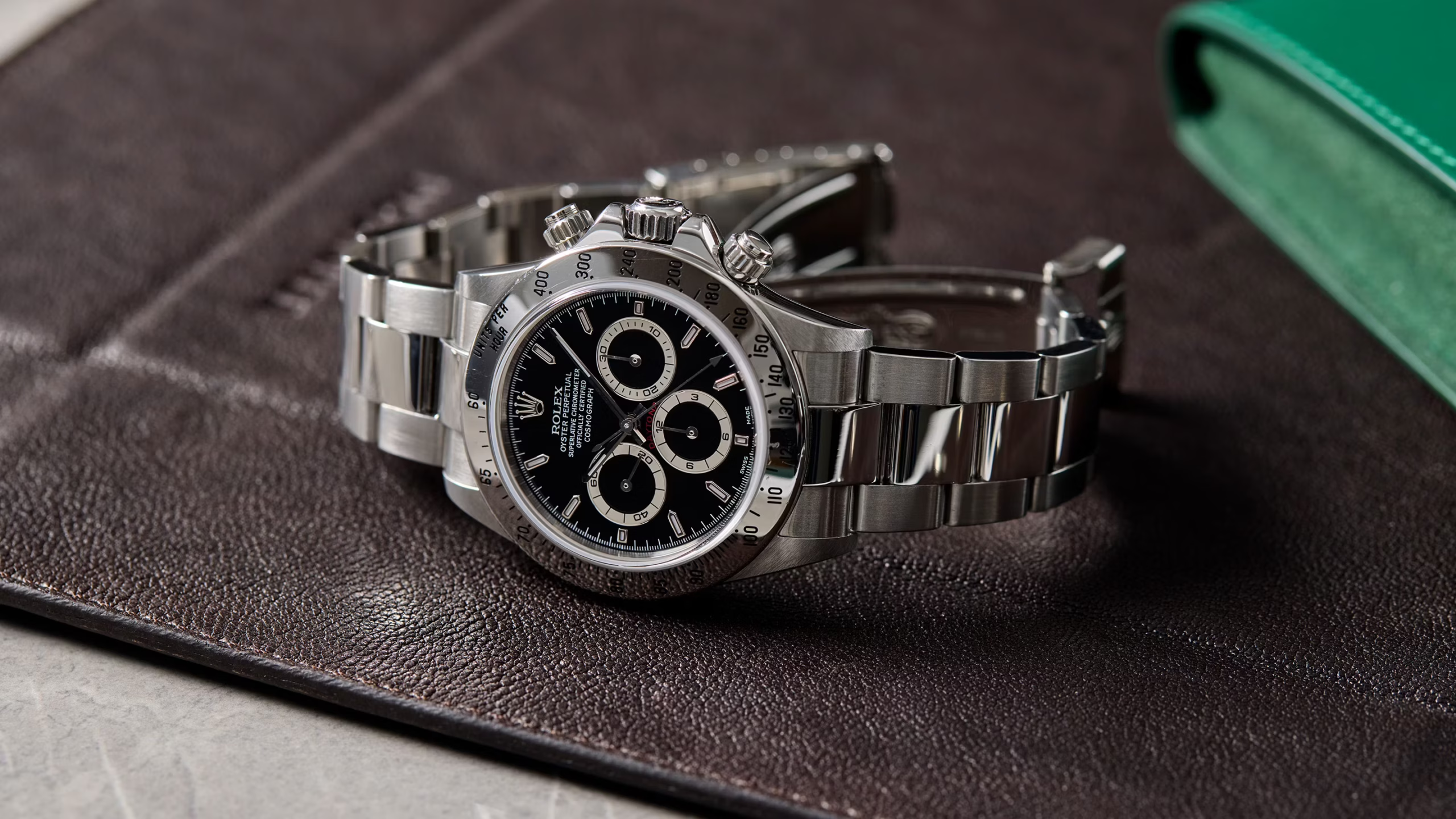
The cases came in steel and in gold. The dials came in black, silver, white, and — for a limited period — the "exotic" or "Paul Newman" configuration with its distinctive outer minute track and square-faceted subsidiary dials. The exotic dials were made by Singer (a dial manufacturer, not the sewing machine company) and were produced in relatively small numbers. Their rarity, combined with their distinctive appearance and Paul Newman's association, makes them the most valuable Daytona variants by a significant margin.
The Zenith Era: 1988–2000
In 1988, Rolex faced a decision. The Valjoux supply had run dry, and the brand needed a new movement for the Daytona. Rather than develop their own chronograph caliber from scratch — a multi-year, multi-million dollar undertaking — they turned to Zenith, the Le Locle-based manufacture whose in-house chronograph movement, the El Primero, was considered the finest automatic chronograph caliber in the world.
The El Primero ran at 36,000 vibrations per hour — a high beat rate that allowed it to measure time to one-tenth of a second. Rolex, characteristically, modified it. They reduced the beat rate to 28,800 bph (the standard for Rolex movements) and replaced certain components with their own specifications. Zenith's CEO at the time, Helmut Crott, reportedly instructed his engineers to save a working copy of the original El Primero before the modification — hiding the drawings and parts in a factory wall to preserve the design against Rolex's alterations. The story is part of watchmaking legend.
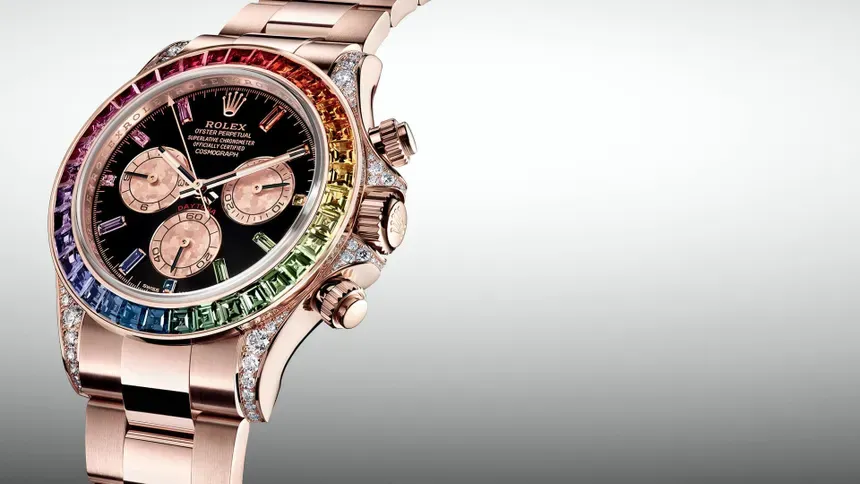
The resulting watch — reference 16520, known to collectors as the "Zenith Daytona" — was an immediate success. It was the first automatic Daytona, ending the era of manual winding. Its case design was cleaner than the earlier references. And it came in versions that remain among the most sought-after Daytonas today: the "inverted six" lug variant, the porcelain dial references, the platinum edition with its distinctive ice-blue dial.
Zenith-era Daytonas in excellent condition sell for significant premiums over the 4130-era references in the collector market — a counterintuitive fact that reflects the collector's preference for historical significance over technical modernity.
The 4130 Revolution: Rolex Takes Control (2000–Present)
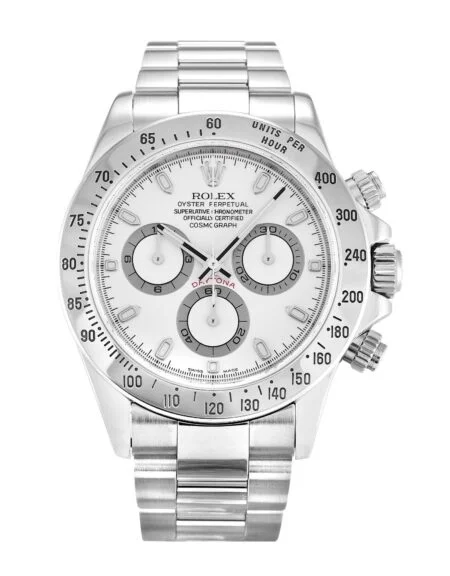
When Rolex unveiled the 116520 at Baselworld in 2000, it represented a decade of development and a fundamental shift in the brand's chronograph strategy. The Cal. 4130 was entirely Rolex's own design — no borrowed architecture, no modified third-party movement. It was the first time in the Daytona's history that Rolex could genuinely say the watch was completely theirs.
The 4130 used a column wheel and vertical clutch — the configuration preferred by premium chronograph makers because it provides a cleaner start/stop feel with minimal jump in the seconds hand at activation. The Zenith El Primero had used a lateral clutch; the transition to vertical clutch improved the push-button experience significantly.
The 4130 also offered a 72-hour power reserve — exceptional for the era — and Rolex's standard level of accuracy and shock resistance. It was regulated to COSC chronometer standards, meaning it kept time within ±4 seconds per day. For a watch that most owners would never use to time a race, these specifications were reassuring rather than necessary.
The 116520 ran from 2000 to 2016. During those sixteen years, it went from slow-selling (familiar territory for the Daytona) to the most coveted steel sports watch in the world. The secondary market premium climbed steadily. Waiting lists at authorized dealers, initially nonexistent, grew to months, then years.
The Ceramic Era: 116500LN and the Grail Reference (2016–Present)
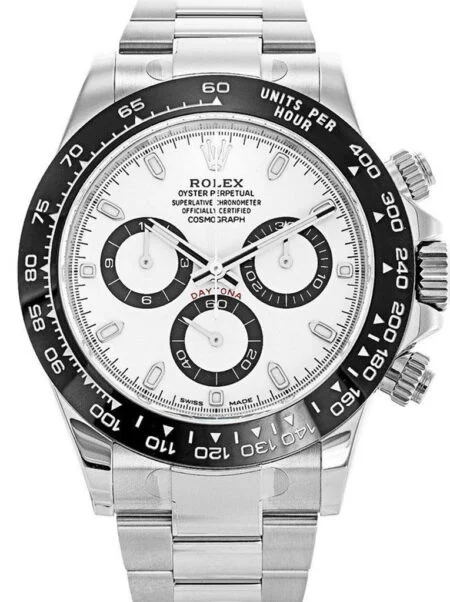
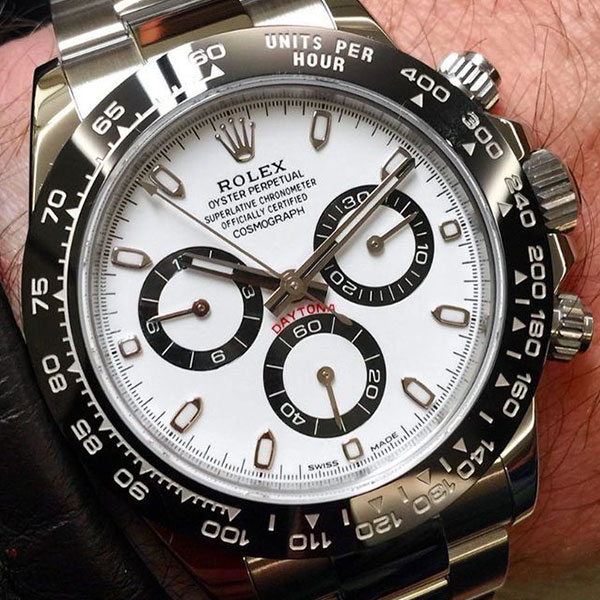
In 2016, Rolex replaced the metal tachymeter bezel of the 116520 with a ceramic Cerachrom insert — available in black or white. The change was both practical and aesthetic. Ceramic Cerachrom does not scratch, does not fade in UV light, and holds its color indefinitely. The metal bezel of the 116520 developed wear character over time; the ceramic bezel does not.
The new reference, 116500LN, launched with two dial configurations: a "Panda" (white dial, black subdials) and a reverse configuration with a black dial and white subdials. Both were immediately popular. Both immediately developed waiting lists at authorized dealers that defied any reasonable estimate of production capacity.
By 2020, the 116500LN Panda in steel was trading at secondary market prices of $30,000–$40,000 — roughly double the retail price of approximately $15,000. By 2026, steel examples routinely change hands at $45,000–$55,000. The watch costs three to four times retail on the open market. For a watch that is theoretically in current production and available through authorized dealers, this situation is without precedent in luxury watchmaking.
The 2023 update — reference 126500LN — refined the bracelet, updated the movement to the Cal. 4131, and made subtle aesthetic adjustments. The secondary market reception was equally enthusiastic.
The $17.8 Million Moment: Newman's Watch at Auction
In October 2017, Phillips auction house sold Paul Newman's personal Daytona — the specific watch that Joanne Woodward had given him, with "Drive Carefully Me" engraved on the caseback — for $17.75 million. The pre-sale estimate had been $1–3 million. The final price was more than five times the estimate and established a new record for the most expensive wristwatch ever sold at auction.
The buyer was James Lamphier, bidding on behalf of an undisclosed principal. The watch was purchased outright; there was no reserve that had been reached. The $17.75 million was simply what someone was willing to pay for this specific object, with this specific history, at this specific moment.
The auction created ripple effects throughout the entire watch market. Prices for any exotic-dial Daytona reference — any "Paul Newman" variant — moved significantly upward in the months following. The concept of a watch's provenance — its specific history of ownership and use — moved from a niche collector concern to mainstream awareness.
It also crystallized the Daytona's unique position. This was not simply the most valuable Rolex. This was the most valuable wristwatch. Period. A production watch — one of thousands made — was now worth more than nearly any pocket watch ever produced, more than most paintings, more than significant works of decorative art. The story behind it had transformed its value beyond any reasonable relationship to its materials.
The Daytona's Cultural Descendants: Special Editions and Icons
The Daytona's story did not end with the 116500LN. Rolex has continued to release special variants that extend the mythology.
The "John Mayer" Daytona — the yellow gold 116508 with green dial that John Mayer made famous through his social media presence — is now one of the most referenced collector's Daytonas despite being in current production. The musician's enthusiastic documentation of the watch transformed collector attention toward it.
The Le Mans 100 Anniversary Edition (2023) marked the centenary of the 24 Hours of Le Mans with a white gold Daytona featuring a unique two-register dial treatment. Limited production made it immediately collectible.
The Ice Blue Platinum Daytona — available only in platinum, with a distinctive light blue dial — represents the most precious metal variant of the Daytona. Retail price in 2026 exceeds $80,000. Secondary market prices are proportionally elevated.
Why the Daytona Became the Super Clone Market's Obsession
The Daytona's journey from commercial failure to $17.8 million auction record to waiting-list grail to super clone market obsession is a perfect parable about how value is constructed in contemporary culture.
The watch is technically exceptional — the 4130 movement is one of the finest automatic chronographs ever made. But technical excellence alone doesn't generate the Daytona's cultural position. The watch also tells a story: it is the watch of Paul Newman, of Eric Clapton, of John Mayer, of Jay-Z. It is the watch that went from $300 to $17.8 million. It is the watch that motorsport built and music adopted and hip-hop claimed as its own.
When buyers approach the super clone Daytona market, they are not just buying a chronograph. They are choosing to participate in this story at a price point that was previously unavailable to them. The cultural weight of the Daytona is not diminished by wearing a super clone version; it is accessed through it.
By 2026, the super clone Daytona represents the market's most technically demanding achievement and its most emotionally resonant product. Manufacturers invest their best capabilities in it because buyers want it most. The ceramic bezel is correct. The column wheel works. The subdials are perfectly recessed. The bracelet has the right weight. What you hold in your hand is not Paul Newman's watch. But it is the descendant of the same sixty-year story.
That story — of the watch that started as a failure and became the most coveted watch in the world — is worth knowing before you put one on your wrist.
For those ready to explore the current super clone Daytona market, begin with our 2026 Ultimate Guide to Rolex Daytona Super Clones and our complete buying guide. The sixty-year story continues, and your wrist is part of it.