
Ultimate Guide to Rolex Explorer Super Clones 2026
Updated for 2026 · 17 min read
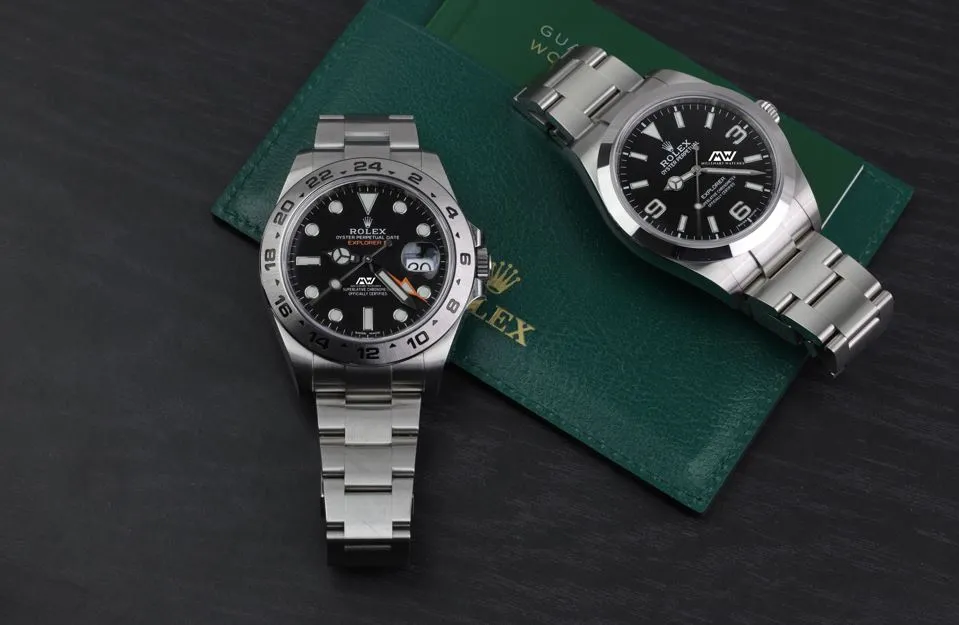
At 11:30 AM on May 29, 1953, Edmund Hillary and Tenzing Norgay became the first human beings to stand on the summit of Mount Everest. Hillary wore a Rolex on his wrist. When word reached Buckingham Palace in time for Queen Elizabeth II's coronation the following morning, Rolex had their story. They launched the Explorer that same year — a watch named for the act that had just proven it could go anywhere.
The Explorer is Rolex at its most minimal. No complications, no date, no color — just a black dial, white 3-6-9 Arabic numerals, applied hour markers with generous luminous fill, and a case engineered to withstand conditions that most watches would not survive. It is the purist's Rolex, the one that watch enthusiasts consistently rank as the model they would choose if they could only have one.
In 2026, the Explorer super clone market has produced some remarkable pieces. This guide covers the history, the key references, and what to look for when evaluating an Explorer super clone.
The Explorer's Design Philosophy: Nothing Extra
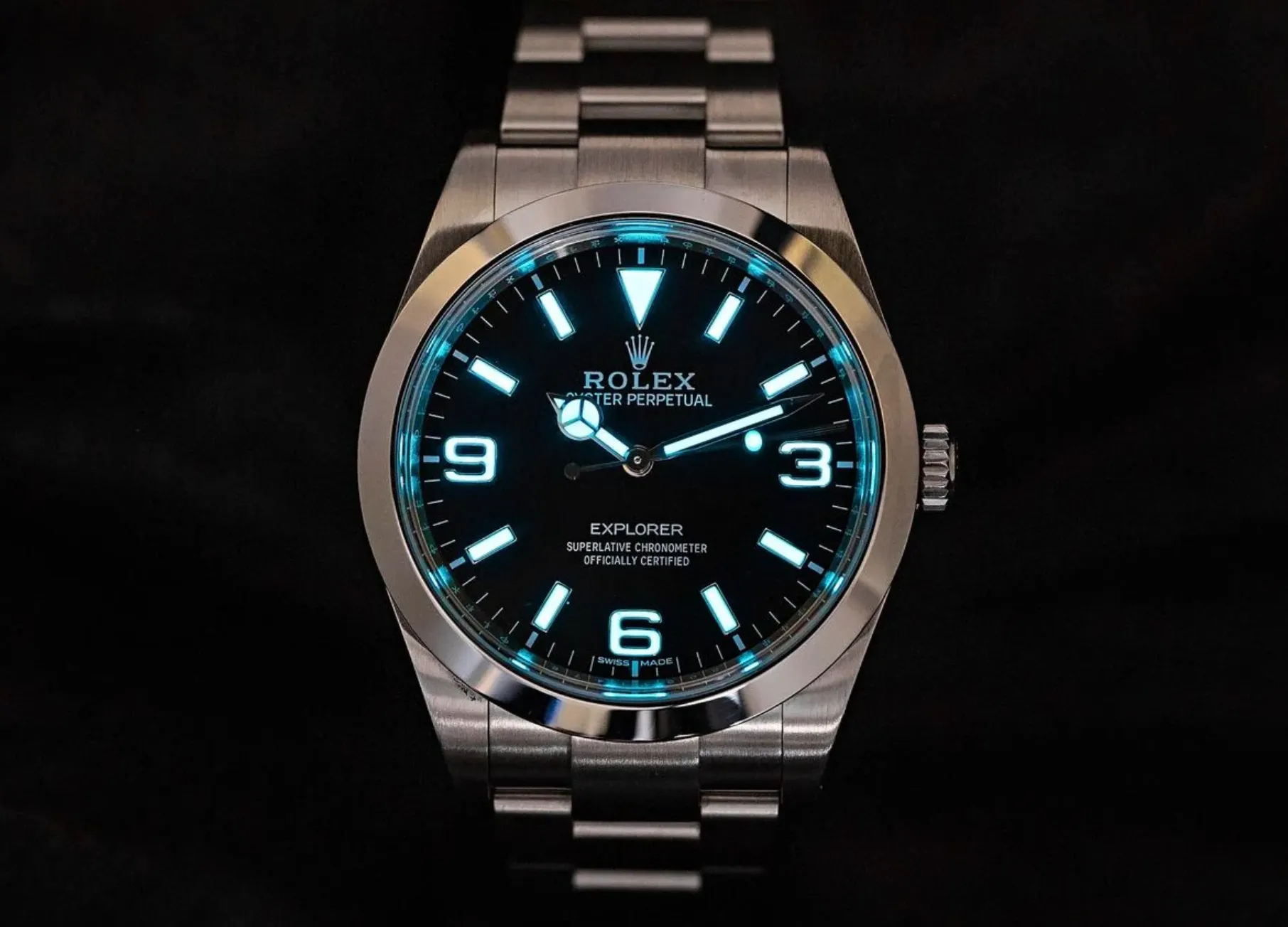
The Explorer's design has been remarkably consistent across seven decades. The black dial with white numerals creates maximum contrast for legibility in low-light conditions — exactly what a mountaineer or cave explorer needs when time matters and natural light is absent. The 3, 6, and 9 positions use Arabic numerals because they are faster to read than indices; all other hours use applied rectangular markers.
The lume is the Explorer's most important functional feature. Rolex introduced Chromalight — their proprietary blue-emitting luminous material — in 2008, replacing the green-emitting SuperLuminova they had previously used. Chromalight glows for up to eight hours, twice as long as conventional luminous compounds. On a wrist in total darkness, the Explorer's dial glows a pale, cold blue that is both beautiful and exactly as functional as intended.
The case has grown incrementally over the decades. The original references measured 36mm, which was considered a substantial sports watch in the 1950s. The 2010 Explorer I (reference 214270) expanded to 39mm. The 2021 update returned to 36mm — acknowledging that the original proportions had always been correct.
Key Explorer References: The Collector's Timeline
Reference 1016 (1963–1989): The longest-running Explorer reference, produced for 26 years. The 1016 has an almost mythological status among Rolex collectors — it is the Explorer that serious vintage collectors pursue. Its appeal lies in its purity: a 36mm case, no Cyclops, no date, nothing but the black dial and the movement inside.
Reference 14270 (1990–2001): The transition reference. Updated case architecture, new bracelet, and the move to sapphire crystal. Still 36mm, still no date. This reference is undervalued in the collector market relative to the 1016, which makes it interesting for value-focused buyers.
Reference 114270 (2001–2010): Small updates continued Rolex's refinement program. The 3235's predecessor movement. Often confused with the 14270 by casual observers.
Reference 214270 (2010–2021): The 39mm Explorer. Controversial at launch for its size departure; accepted over time as a legitimate evolution. The 2016 update added larger luminous plots and improved finishing.
Reference 124270 (2021–present): The current Explorer. Back to 36mm with the 3230 movement — Rolex's latest non-date caliber. The 3230 features the Chronergy escapement for improved efficiency and a 70-hour power reserve. This is the reference that dominates the current super clone market.
Explorer II: The Cave Explorer's Companion
The Explorer II, introduced in 1971, was designed specifically for speleologists — cave explorers — who needed to distinguish AM from PM in environments where daylight never penetrated. The solution was a 24-hour hand that pointed to a fixed 24-hour bezel: red to distinguish AM from PM.
The Explorer II evolved into something different from its original brief. The 216570 "Polar" version — with a white dial and orange 24-hour hand — became a cult object among adventure travelers, Arctic researchers, and anyone who appreciated a watch that remained functional in the extreme conditions where most others failed.
Super clone versions of the Explorer II capture the distinctive 42mm case, the fixed 24-hour bezel, and the unique hand configuration. The "Polar" white dial version is particularly sought-after in the super clone market.
Why the Explorer Is the Hardest Rolex to Fake Convincingly
Counterintuitively, the Explorer's simplicity makes it harder to replicate convincingly than more complex watches. When there is nothing to distract the eye — no complications, no colorful bezel, no complex dial layout — every single element must be perfect. Imperfect lume plots. Slightly soft dial printing. A case finish that blurs the line between polished and brushed surfaces. Any of these errors are immediately visible on an Explorer because there is nowhere to hide them.
This is why the Explorer separates the best super clone manufacturers from the merely competent ones. A Daytona can distract with its complexity. An Explorer cannot. Only the manufacturers with genuine precision in their case machining, dial production, and finishing can produce an Explorer that passes close inspection.
For guidance on evaluating quality, visit our complete buying guide and our section on what separates super clones from ordinary fakes.
What to Look For in an Explorer Super Clone
When evaluating an Explorer super clone, these are the critical quality indicators:
Dial printing sharpness: The 3, 6, and 9 Arabic numerals must be crisp-edged under magnification. Any softness or bleeding in the white printing indicates mass-production shortcuts. The "EXPLORER" and "SUPERLATIVE CHRONOMETER / OFFICIALLY CERTIFIED" text should be sharp and evenly weighted.
Lume quality: The luminous fill in the hour markers and hands should be level with the surrounding surfaces and uniformly applied. Uneven fill, visible bubbles, or lume that sits proud of the marker edges indicates lower manufacturing standards.
Case surface transitions: The Explorer case has precisely defined transitions between polished and brushed surfaces. The tops of the lugs are brushed; the sides are polished; the case band transitions between the two. Each transition should be sharp and deliberate, not gradual and blurred.
Oyster bracelet quality: The Explorer wears an Oyster bracelet with the Oysterclasp. The bracelet should have appropriate weight, link-to-link movement without excessive play, and clean clasp operation. The Easylink extension system on current references should function smoothly.
Crown operation: The Explorer's screw-down crown should engage the case threads smoothly and lock with appropriate resistance. The winding position should engage cleanly, and time-setting should be precise without the dial's seconds hand jumping.
The Explorer's Cultural Weight in 2026
The Explorer occupies a unique cultural position in 2026. In an era when watch collecting has become partly performance — when the Daytona's cultural associations make it a status signal as much as a watch — the Explorer functions as a counter-signal. It says: I know enough about watches to choose the one that gets everything right, even though it has nothing to show off.
This is why watch enthusiasts consistently rate it as the model they would choose for a desert island scenario. It is not about rarity or prestige or investment value. It is about the satisfaction of owning something that was designed with single-minded purpose and has never compromised that purpose in seven decades.
The super clone market understands this. The Explorer super clones available in 2026 are made for buyers who appreciate exactly what makes the original worth wanting — not the name on the dial, but the rightness of every decision that went into it.
Edmund Hillary wore his Rolex to the top of the world. Nobody else will ever be first on Everest. But the satisfaction of wearing a watch made with that same philosophy — built for purpose, finished with precision, designed to last — is available to anyone who chooses it.