
Ultimate Guide to Rolex Explorer Super Clones 2026
Updated for 2026 · 6 min read
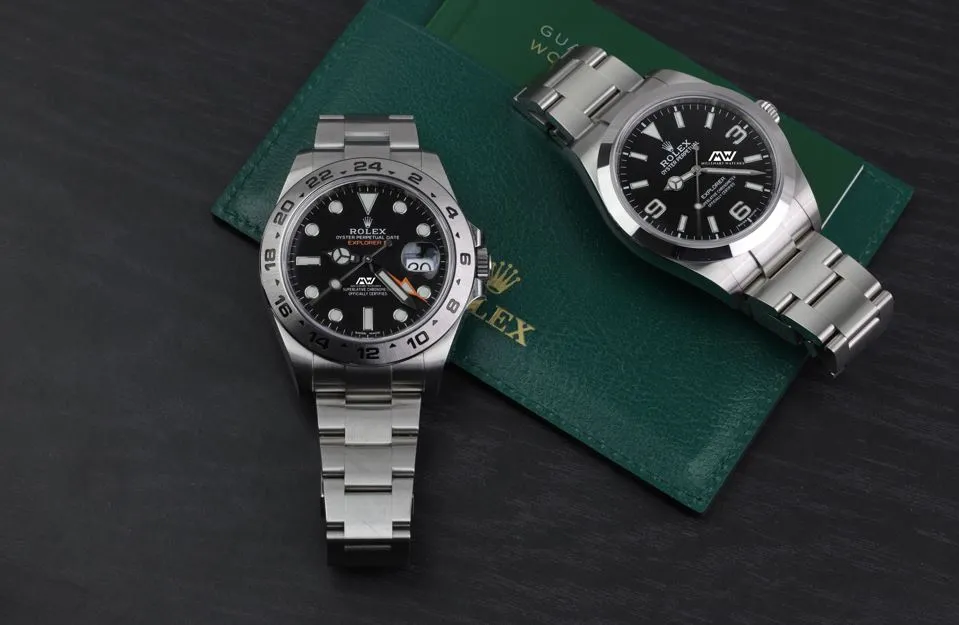
At 11:30 AM on May 29, 1953, Edmund Hillary and Tenzing Norgay became the first people to stand on the summit of Mount Everest. Hillary wore a Rolex. Word reached Buckingham Palace in time for Queen Elizabeth II's coronation the next morning, and Rolex had their story. They launched the Explorer that same year. The name honored the act that had just proven the watch could go anywhere.
The Explorer is Rolex at its most minimal. No complications, no date, no color. You get a black dial, white 3-6-9 Arabic numerals, and applied hour markers with generous luminous fill. The case is built to survive conditions that would kill most watches. It is the purist's Rolex. Ask enthusiasts which model they would keep if they could own only one, and the Explorer wins again and again.
The Explorer super clone market has produced some excellent pieces. This guide walks through the history, the key references, and what to check before you buy. New to this world? Our start here guide for super clones covers the basics first.
The Explorer's Design Philosophy: Nothing Extra
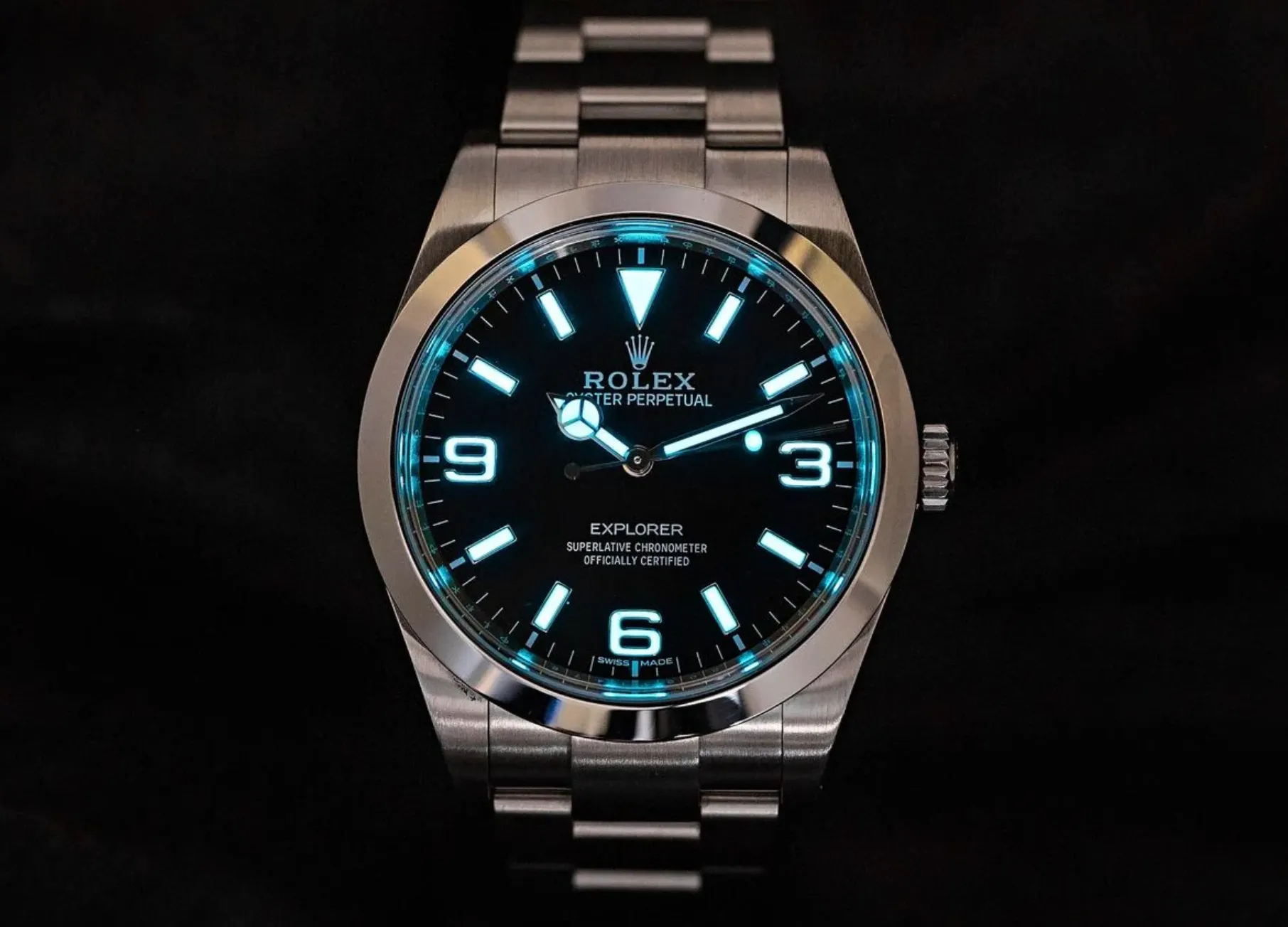
The Explorer's design has held steady for seven decades. The black dial and white numerals create maximum contrast, so the watch stays legible in low light. That is what a mountaineer or cave explorer needs when time matters and the sun is gone. The 3, 6, and 9 positions use Arabic numerals because they read faster than indices. Every other hour uses an applied rectangular marker.
The lume matters more here than on any other Rolex. In 2008 Rolex switched to Chromalight, its own blue-emitting luminous material. It replaced the green-emitting SuperLuminova used before. Chromalight glows for up to eight hours, twice as long as older compounds. In total darkness the dial gives off a pale, cold blue. It looks beautiful, and it works just as the design intends.
The case has grown in small steps over the years. The original references measured 36mm, a substantial sports watch by 1950s standards. The 2010 Explorer I (reference 214270) grew to 39mm. The 2021 update went back to 36mm. Rolex had admitted the original proportions were right all along.
Key Explorer References: The Collector's Timeline
Reference 1016 (1963–1989): Rolex made it for 26 years, longer than any other Explorer. Among collectors it carries an almost mythical status, and serious vintage buyers chase it. The appeal is its purity: a 36mm case, no Cyclops, no date, nothing but the black dial and the movement inside.
Reference 14270 (1990–2001): The transition reference. It brought updated case architecture, a new bracelet, and the move to sapphire crystal. Still 36mm, still no date. The market values it below the 1016, which makes it a smart pick for value-focused buyers.
Reference 114270 (2001–2010): More small updates in Rolex's steady refinement. It used the predecessor to the 3235 movement. Casual observers often confuse it with the 14270.
Reference 214270 (2010–2021): The 39mm Explorer. The size jump drew complaints at launch, then earned acceptance as a real evolution. The 2016 update added larger luminous plots and better finishing.
Reference 124270 (2021–present): The current Explorer. It returns to 36mm with the 3230, Rolex's latest non-date caliber. The 3230 uses the Chronergy escapement for better efficiency and holds a 70-hour power reserve. This is the reference that drives the current super clone market.
Explorer II: The Cave Explorer's Companion
Rolex built the Explorer II in 1971 for speleologists. These cave explorers could not tell AM from PM, since daylight never reached them. The fix was a 24-hour hand pointing to a fixed 24-hour bezel. The red marking tells AM from PM.
The Explorer II grew into something beyond its original brief. The 216570 "Polar" version, with a white dial and orange 24-hour hand, became a cult object. Adventure travelers and Arctic researchers reached for it. So did anyone who wanted a watch that kept running where lesser watches quit.
Super clone versions of the Explorer II capture the distinctive 42mm case, the fixed 24-hour bezel, and the unusual hand layout. The "Polar" white dial is the one buyers want most in the super clone market.
Why the Explorer Is the Hardest Rolex to Match Convincingly
The Explorer's simplicity makes it harder to copy than busier watches. Nothing distracts the eye here. No complications, no colorful bezel, no crowded dial. So every element has to be perfect. A lume plot slightly off. Soft dial printing. A case finish that blurs the line between polished and brushed metal. Any of these flaws jumps out on an Explorer, because there is nowhere to hide them.
This is why the Explorer separates the best super clone makers from the merely competent. A Daytona can hide behind its complexity. An Explorer cannot. It takes real precision in case machining, dial work, and finishing. Only the top makers can build one that survives close inspection.
Want help judging quality? Read our complete buying guide . Then see our section on what separates a super clone from a cheap build .
What Separates a Good Explorer Super Clone
Here are the quality indicators that matter most on an Explorer super clone — every reference in our Explorer collection is checked against them. Torn between the Explorer and another model? Use our tool to find your match before you commit.
Dial printing sharpness: The 3, 6, and 9 Arabic numerals must hold crisp edges under magnification. Softness or bleeding in the white printing points to mass-production shortcuts. Look for sharp, even weight in the "EXPLORER" and "SUPERLATIVE CHRONOMETER / OFFICIALLY CERTIFIED" lines.
Lume quality: The luminous fill in the hour markers and hands should sit level with the surrounding surfaces and go on evenly. Uneven fill, visible bubbles, or lume that sits proud of the marker edges signals lower standards.
Case surface transitions: A real Explorer draws sharp lines between polished and brushed metal. The tops of the lugs are brushed. The sides are polished. The case band shifts between the two. Each transition should look crisp and deliberate, never gradual or blurred.
Oyster bracelet quality: The Explorer wears an Oyster bracelet with the Oysterclasp. It should feel suitably heavy, move link-to-link without sloppy play, and open and close cleanly. On current references the Easylink extension should glide smoothly.
Crown operation: The screw-down crown should meet the case threads smoothly and lock with firm resistance. The winding position should engage cleanly, and time-setting should feel precise, with no jump in the seconds hand.
The Explorer's Cultural Weight in 2026
The Explorer holds a quiet, unusual place in 2026. Watch collecting has turned partly into performance. The Daytona now reads as a status signal as much as a watch. Against that, the Explorer works as a counter-signal. It says you know enough about watches to pick the one that gets everything right, even though it has nothing to show off.
That is why enthusiasts keep naming it as their desert-island watch. The point is not rarity or prestige or resale value. The point is owning something built with one clear purpose that has never wavered from it in seven decades.
The super clone market gets this. The 2026 Explorer super clones are made for buyers who value what makes the original worth wanting. Not the name on the dial, but the rightness of every choice behind it.
Edmund Hillary wore his Rolex to the top of the world. No one else will ever be first on Everest. But a watch built with that same philosophy, made for purpose, finished with precision, and designed to last, is within reach of anyone who chooses it.