
Rolex GMT-Master II: References, Bezels & Cal. 3285 Movement
Published · Updated · 9 min read
The year was 1954. Pan American World Airways had just launched its Boeing 377 Stratocruiser route across the North Atlantic. New York to London took fourteen hours. For the first time in commercial aviation, pilots had to track several time zones at once. So Pan Am's chief of technical operations went to Rolex with one request: build a watch that shows two time zones at the same time.
The answer was the GMT-Master. Rolex showed it at the 1954 Geneva Watch Fair and issued it to Pan Am pilots the next year. It added a fourth hand, the GMT hand, which makes one full turn every 24 hours and points to a rotating bezel marked in 24-hour steps. The bezel was red and blue: red for day, blue for night. Pan Am pilots called it the Pepsi.
More than seventy years on, the Rolex GMT-Master II is still the most refined pilot's watch ever made. The 1983 update let owners set the local hour hand on its own. Its colorway nicknames are now part of watch slang: Batman, Pepsi, Sprite, Root Beer, Bruce Wayne. And in 2026 it sits second only to the Submariner as the most replicated Rolex. The best super clones now run close to the real thing. This guide covers what the top GMT super clones get right and the references that matter. It also breaks down the movement and bezel tech that splits the tiers, plus how to buy without getting burned. If you are new to super clones, our start here primer covers the basics first.
Understanding the GMT-Master II Complication
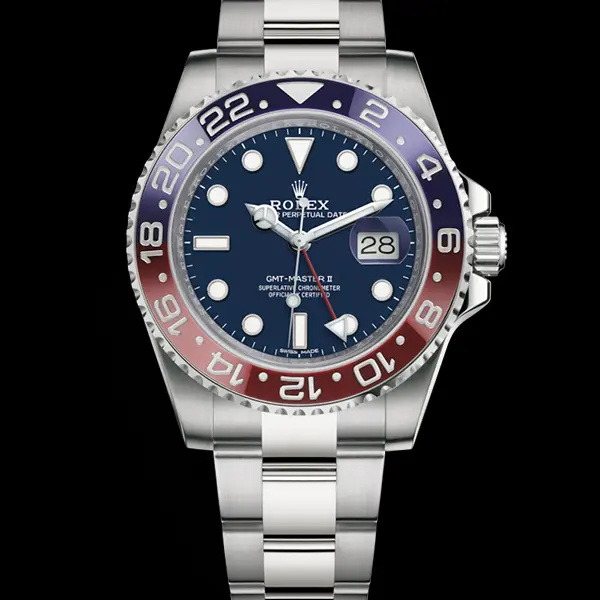
The GMT-Master II tracks three time zones at once. The 24-hour GMT hand and bezel show home time. The adjustable hour hand shows local time. A second mark on the 24-hour bezel gives you a third zone. Minutes and seconds stay the same across all of them.
The Quick Set independent hour hand system, introduced on the 1983 GMT-Master II, makes this work. It ranks among Rolex's most important contributions to watchmaking. You move the local hour hand in one-hour steps without stopping the watch. So a traveler resets to a new time zone the moment they land, and the movement never pauses.
Copying this at the super clone level takes real movement engineering. The GMT-Master II runs on the calibre 3285, an evolution of the 3235 with the extra complication for the independent hour hand. A movement that matches this layout needs the right mechanism for hour hand adjustment. A simple four-hand display that only moves the GMT hand does not cut it.
The Colorways: Batman, Pepsi, Sprite, Root Beer
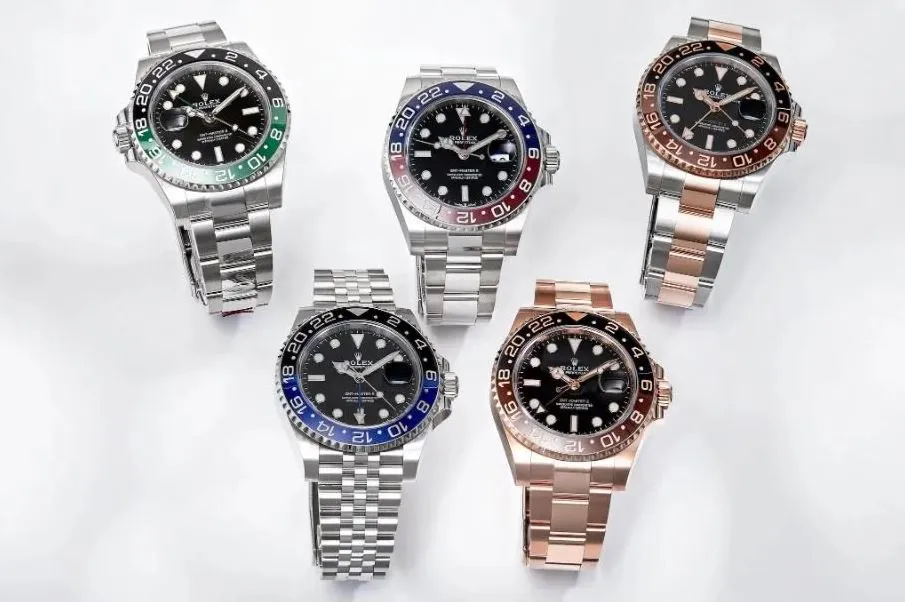
The bezel colorways have grown into cultural objects in their own right. Each has its own fan base, its own price premium, and its own waiting list. In 2026, four variants drive most super clone demand:
Batman (126710BLNR): black and blue ceramic bezel, jubilee bracelet. Rolex launched the Batman in 2013 as the first two-color ceramic bezel GMT, replacing the older aluminum-bezel version. On the jubilee bracelet, added to this reference in 2019, it wears dressier than the Submariner. This is the most-requested GMT super clone.
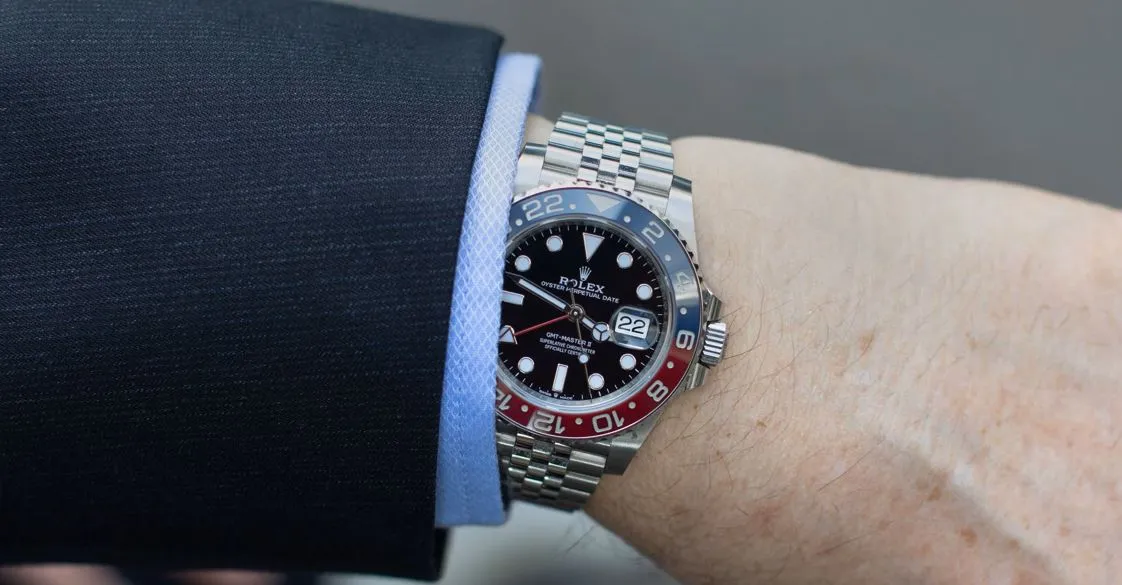
Pepsi (126710BLRO): red and blue ceramic bezel, jubilee bracelet. This is the original colorway. Rolex retired it from steel in 2007, before two-color ceramic was ready, and kept it alive in white gold only. The ceramic steel version returned in 2018. The Pepsi carries more history than the Batman because it came first. Its return after an eleven-year gap in steel made it one of the most wanted Rolexes around.
Sprite/Starbucks (126720VTNR): green and black ceramic bezel. Rolex showed it at Watches & Wonders 2022 with a twist: a left-hand crown at 9 o'clock. That choice makes it the only current steel Rolex built this way. The green-and-black bezel looks unlike any other GMT, and it pulled instant gray market premiums.
Root Beer (126711CHNR): brown and black ceramic bezel, Rolesor gold and steel build. The amber tone nods to the soda it is named for. It has a loyal following for its warmer, more autumnal look. The two-tone build gives it a dressy edge the all-steel models lack.
A fifth reference widened the palette: the Bruce Wayne (126710GRNR), with a grey-and-black ceramic bezel and green accents on the dial and GMT hand, shown at Watches & Wonders 2024 (WatchesBySJX's hands-on). Super clones of it landed within months of the real release. That shows how fast the super clone trade now reacts to new Rolex models. Quality swings more on newer references, since makers have had less time to refine their process. Give the bezel the same scrutiny you would the Batman or Pepsi.
Vintage GMT-Master References: What Collectors Chase
The modern ceramic references draw most super clone demand. But the GMT-Master's lineage is part of what gives the watch its weight. So several historical references get replicated for collectors who want the vintage shape. The original 6542 (1954–1959) wore a Bakelite bezel. Rolex later recalled it for radioactivity, which makes real examples vanishingly rare. The 1675 (1959–1980) is the definitive vintage GMT. It carried the watch through the jet age, and it is the one tied to the "Pussy Galore" aluminum-bezel era.
The transitional 16760 (1983) earned the nicknames "Fat Lady" and "Sophia Loren" for its thicker case. It was the first true GMT-Master II and brought the red-and-black "Coke" bezel. The 16710 (1989–2007) closed out the aluminum-bezel era. Collectors love it because one reference came in Pepsi, Coke, and all-black. Super clones of these vintage refs lean on aged-lume dials and aluminum bezel inserts, not ceramic, to nail the period look. That is a different job from the modern Cerachrom references above.
The Two-Color Ceramic Bezel: The Technical Mountain
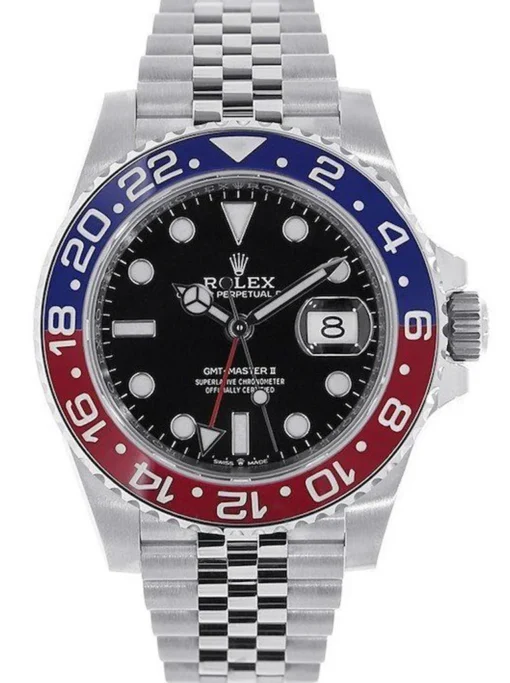
A single-color Cerachrom bezel is already hard to make. A two-color one is harder still. It needs a razor-sharp line between the colors, the same pigment depth on both halves, and even surface quality across the whole ring. Few tasks in watch production are this demanding.
Rolex makes the two ceramic halves separately, then fuses them during sintering at over 1,400 degrees Celsius. The heat behavior of each color has to match exactly. Different pigments sinter differently, and a mismatch would warp the bezel, crack it, or ruin the color line.
For the workshops, this is the main quality barrier. Cheap bezels are painted or lacquered. They look close at first, then fade within months. A hard-anodized aluminum insert resists fading better but still bleeds color at the boundary over time. A handful of super clone makers have invested in real ceramic production by 2026. Their bezels match the genuine hardness, color depth, and sharp color line.
The bezel is the single biggest quality marker on a GMT-Master II super clone. It is also the most expensive part to get right. When you size up a GMT super clone, the bezel tells you nearly everything about how serious the maker is.
Movement Depth: Crown Function and Power Reserve
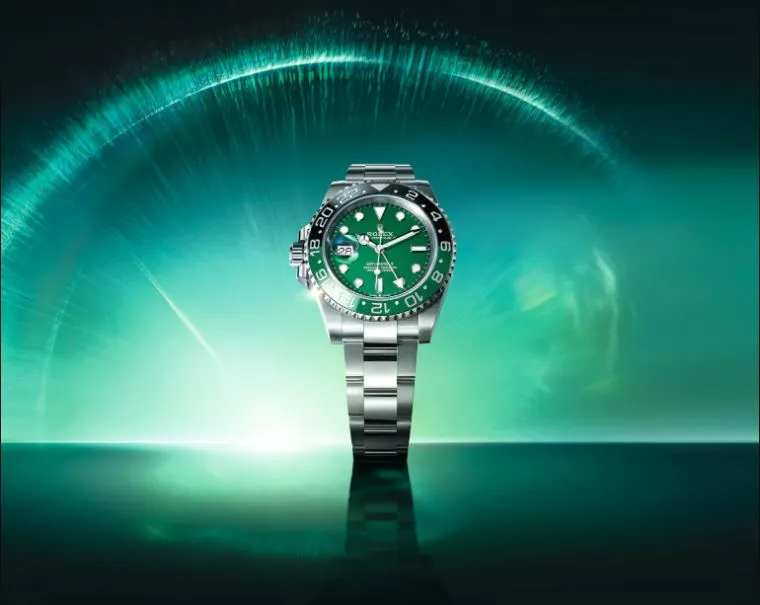
The genuine calibre 3285 gives you 70 hours of power reserve and +2/-2 seconds per day, and its blue Parachrom hairspring resists magnetism. The key trick is the Quick Set GMT system. Push the crown at position 2 to move the GMT hand on its own. Pull to position 3 to set the adjustable local hour hand.
Super clone movements copy this layout with mixed accuracy. The best ones match all three crown positions, hold 60-70 hours of power reserve, and run at ±5 seconds per day. The GMT function works as it should. The 24-hour hand makes one turn per day, the local hour hand sets in one-hour steps, and the bezel lines up with the 24-hour hand. For how the calibre 3285 maps to its clone movement across every Rolex model, see our Rolex caliber-to-clone movement chart .
Weaker movement clones cut corners. Some use only two crown positions, which kills the independent GMT function. Some hold less power reserve. Others use a different movement that looks wrong next to a real 3285 through a clear caseback.
Jubilee or Oyster: Which Bracelet to Pick
The current GMT-Master II comes on two bracelets. The Oyster is five-link and three-row. The jubilee is five-link with polished center links. Rolex brought the jubilee to the GMT in 2019, and it is now the more popular pick. Its finer look suits the watch's split pilot-and-dress personality.
A super clone jubilee is harder to build than an Oyster. Its five-link design with polished center links needs finer machining for the right articulation and look. Solid-link jubilee construction is the standard at the top of the market, and it gives the bracelet the correct weight and drape. Hollow-link jubilees feel clearly lighter and catch the light wrong.
A quality super clone should have a working Oysterlock clasp with the Easylink extension. The clasp is one of the more visible quality markers on any Rolex bracelet.
Buying a GMT Super Clone: What to Prioritize and Where to Find One
When you shop the GMT-Master II super clone market, work this priority list. Not sure which colorway suits you? Our find your match tool narrows it down fast.
- Ceramic bezel quality. This one is non-negotiable. Confirm ceramic, not painted aluminum, with a hardness test. Check that the color line is sharp and the depth is even across both halves.
- GMT function. Test the independent hour hand and the GMT hand through the crown positions. A GMT that works points to a quality movement.
- Case proportions and finishing. The case should match published dimensions, including the Cyclops magnifier over the date, the crown guard shape, and the lug profile.
- Bracelet and clasp. Solid links, the correct Easylink extension, and a clean Oysterlock clasp engagement.
On price, the 2026 GMT super clone market tiers much like the Submariner. Budget pieces run painted bezels and generic movements. Mid-tier wearers use hard-coated inserts. The super clone tier brings genuine ceramic bezels and movements worth the upgrade. The bezel and movement are where the money goes. So a Batman or Pepsi priced well below its peers has almost always cut one of those two corners. Buy from a seller who photographs the real movement and bezel, sends QC images before shipping, and stands behind the watch. Skip the marketplace listing with stock photos.
Browse our current GMT-Master II super clone collection for live Batman, Pepsi, Sprite and Root Beer stock. The Pepsi GMT's steel discontinuation is part of a wider 2026 shake-up, which we cover in our Rolex discontinued watches 2026 guide . For the full evaluation framework, see our buying guide .
The GMT-Master II has real purpose. It was a tool built to solve one problem, multi-timezone tracking, and it became an icon through how cleanly it solved it. In super clone form, you get that purpose and that icon at a price set by the build, not the provenance. If you want to wear and use one of watch design's great achievements, it is one of the best buys in the 2026 super clone market.